
RED: Engineering Portugal’s Hybrid Rocket Future
Introduction
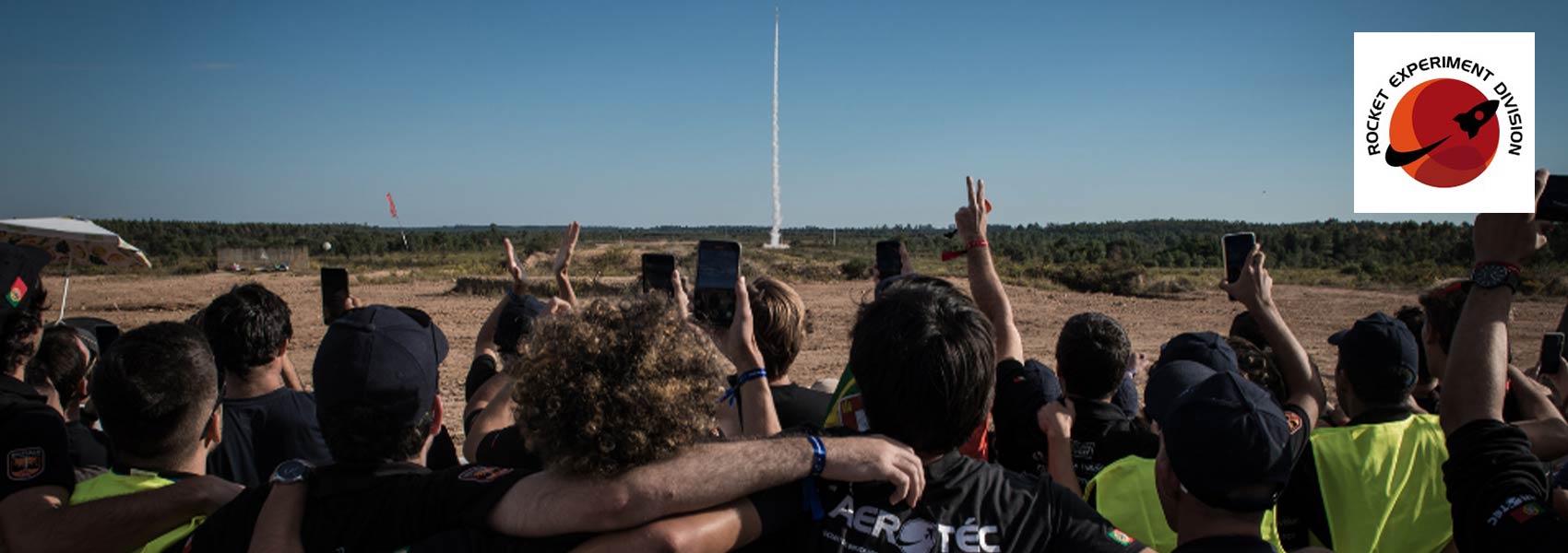
The Rocket Experiment Division (RED), a specialized engineering team within AeroTéc at Instituto Superior Técnico in Lisbon, is composed of passionate students dedicated to pushing the boundaries of collegiate aerospace technology. Our primary focus is the research, design, and manufacturing of advanced hybrid rockets specifically engineered to reach the 3,000-meter altitude class. By developing these complex launch vehicles entirely from scratch—from the propulsion systems to the custom avionics—we aim to bridge the gap between theoretical knowledge and practical aerospace engineering, equipping our team members with hands-on experience in one of the most demanding technical fields.
The European Rocketry Challenge (EuRoC), held annually in Portugal, represents the premier stage for university aerospace engineering in Europe and the ultimate proving ground for our work. For the RED team, this event is not just a date on the calendar, but the culmination of a full year of research, design iterations, and exhaustive bench testing.
The competition brings together the top student teams on the continent in a high-pressure environment where every subsystem is pushed to its absolute limit. Launching a hybrid rocket into the 3000-meter altitude class leaves zero room for error. The extreme G-forces at liftoff, severe engine vibrations, and the need for flawless timing during parachute deployment demand infallible electronic systems. It is in this unforgiving environment, where success and failure are separated by fractions of a second, that the precision and reliability of our avionics become the backbone of the entire mission.
To achieve a successful flight at EuRoC, absolute reliability is non-negotiable. The avionics bay functions as the brain of our rocket, responsible for processing critical telemetry, managing the hybrid engine, and triggering the recovery system at the exact moment of apogee. A single point of failure in our printed circuit boards (PCBs) caused by intense launch vibrations or mechanical stress could compromise the entire mission. To meet these extreme aerospace demands, we partnered with Eurocircuits. Knowing that our designs were manufactured with their industry-leading precision and rigorous quality control gave us the ultimate confidence that our custom electronics would not only survive the harsh conditions of flight but perform flawlessly when it mattered most.
The Demanding Technical Requirements of PESSOA
The Role of Electronics in Flight: The “brain” of our new rocket for the 3,000-meter altitude class, PESSOA, relies on a distributed and highly redundant electronic architecture. While a primary flight computer manages general navigation, the critical actuation of our hybrid engine, recovery power, and ground systems depends entirely on specialized auxiliary boards. For instance, our hot-standby slave computer, “Maurice”, independently processes pressure and temperature data from the propulsion system, as well as actuating the E-valves and the aerodynamic braking system (Airbrakes)
EuRoC Regulations and Critical Redundancy: To compete on a stage like EuRoC, the design must not have single points of failure. Our mission prioritizes reliability over raw performance, which is heavily reflected in the redundancy of our Printed Circuit Board (PCB) design. The dual-deployment recovery system, which ejects a drogue parachute at apogee and releases the main parachute at an altitude of 450 meters above ground level, is managed primarily by our own Student Researched and Developed (SRAD) electronics but is fully backed by redundant Commercial Off-The-Shelf (COTS) systems, including the mandatory CATS Vega flight computer and telemetry system. If our main flight computer were to experience an anomaly, the redundant systems ensure that the pyrotechnic ejection charges (OBF and Eagle) and line cutters will still deploy safely.
Surviving the Harsh Aerospace Environment: PESSOA’s avionics must operate flawlessly in an extreme mechanical environment generated by our new hybrid motor, NEMO, which uses nitrous oxide and paraffin-based fuel. During launch, our PCBs are subjected to maximum accelerations exceeding 61  and velocities reaching 262
 . Beyond the intense engine vibrations during the powered ascent, all this hardware, which includes independent battery management systems, radios, barometers, and isolated micro-SD flight recorders on each board, must be compactly housed and completely immune to connection failures inside a fuselage with an outer diameter of just 162.4
 . In such a confined space and under immense mechanical stress, the physical integrity of the PCB traces and vias is critical to the mission’s success.
The Design and Specifications of our Custom PCBs
The Avionics Stack: To meet the rigorous demands of the PESSOA mission, our team completely custom-designed a system composed of four PCBs. Three of these boards are vertically stacked inside a custom 3D-printed PETG avionics tower, while the fourth is housed in the Main Valve Bay to interface directly with the propulsion system. Designing these boards required strict adherence to spatial constraints to ensure they fit perfectly within the rocket’s outer diameter.
Maurice (Slave Flight Computer): Built around an STM32F446, this board acts as our hot-standby and hardware controller. It uses PWM to actuate the E-valves, propulsion valves, and the airbrakes servo motor.
Kowalski (Power Management PCB): Crucial for mission safety, this board handles the buck converters (stepping down power to 12V, 7.4V, 5V, and 3.3V lines) and safely isolates the pyro igniters used for the recovery system’s pyrotechnic charges.
Cruz (Ignition & GSE Interface): This board is a critical component of our Ground Support Equipment and Hybrid Ignition System. It manages the umbilical connections, allowing us to keep the rocket’s batteries charged while on the launch rail and ensuring secure communication for the ignition sequence
Stuart” (Automated Filling System): This board is the heart of our remote Filling Station operations. Operating a hybrid motor requires filling the oxidizer ( ) and pressurizer (
 ) tanks precisely and safely from a distance. The Stuart board automates this hazardous process, remotely actuating the high-pressure filling valves, managing the venting systems, and reading the pressure and temperature sensors so our propulsion team can control the entire filling sequence safely from the Ground Station.
Engineering and Manufacturing Decisions: Because our ground support and ignition systems rely on secure wireless communication, the routing on the Cruz board required careful attention to trace impedance to prevent signal degradation. Furthermore, routing power for the demanding 14V, 15Ah pyro and servo battery alongside sensitive 3.3V logic components on the Kowalski board required excellent noise isolation and precise layer stack-ups.
The Cooperation with Eurocircuits: From the Bench to the Launch
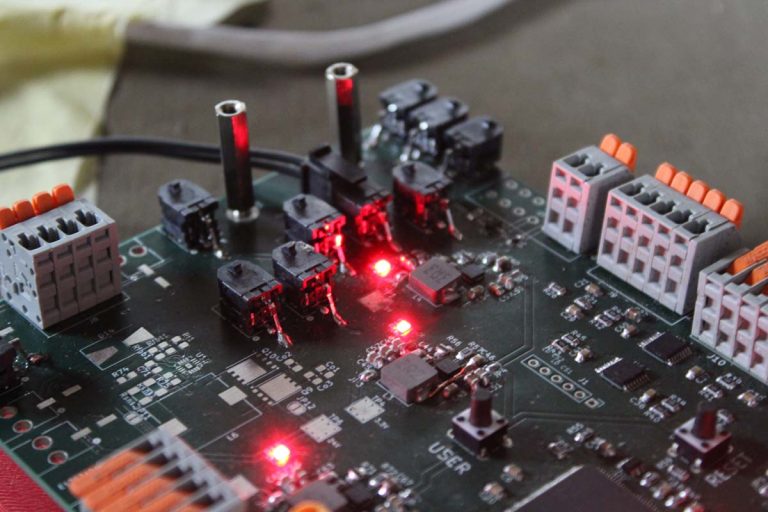
Design Verification and Peace of Mind: Moving from a CAD environment to actual manufacturing is always a critical phase for a student team. Before sending our designs to production, we heavily utilized Eurocircuits’ online PCB Visualizer and their comprehensive Design for Manufacturing (DFM) and Design Rule Check (DRC) tools. Given the complexity of our custom electronics, especially with sensitive data lines running near high-current power traces on the Kowalski and Cruz boards, these tools acted as a vital automated safety net. They allowed us to catch and correct minor clearance and routing issues pre-production, saving us invaluable time and preventing costly redesigns.
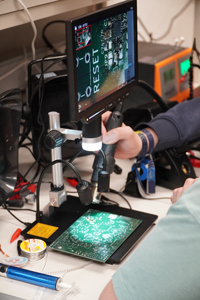
Uncompromising Manufacturing Quality: When you are building a rocket, assembly must be precise. Upon receiving the PCBs, our electronics team immediately noticed the premium manufacturing quality. The precision of the solder mask, the flawless surface finishes, and the exactness of the vias made the integration and soldering of our dense SMD components, like the STM32 microcontrollers and the IMU sensors, remarkably smooth and error-free.
Proving Reliability in the Hot-Static Fire Test: The ultimate validation of manufacturing quality is real-world testing. The true test of these PCBs came during our recent hot-static fire test of the NEMO hybrid motor. A static fire subjects the vehicle to immense acoustic vibrations and mechanical stress. We are thrilled to report that this hot-static fire allowed us to test the new features of this year’s flight avionics, yielding successful results. The Eurocircuits boards performed flawlessly under this punishing environment, continuously logging data to the SD cards and communicating without a single electrical fault.
Meeting Strict Deadlines: The EuRoC operates on a strict, inflexible timeline. A delay in receiving our PCBs could have meant missing critical integration windows. Eurocircuits’ reliable and rapid delivery ensured that we had our hardware exactly when we needed it. This punctuality gave us the breathing room to thoroughly conduct our Hardware-in-the-Loop simulations and our hot-fire testing campaign on schedule.
Final Preparations and the Road to EuRoC 2026
Current Status and Refinements: Mission PESSOA represents another important milestone in RED’s ongoing development of hybrid propulsion technology and launch vehicle design. With our custom avionics stack fully assembled and successfully validated during the recent NEMO hybrid motor static fire test, we are entering the final stretch of our mission. While our electronic systems performed flawlessly, the focus during the remaining development period is on increasing overall system reliability and ensuring that all components perform as expected under flight conditions. We are currently planning additional static fire tests to fine-tune our propulsion system, specifically to improve oxidizer temperature management and pressure regulation for optimal performance.
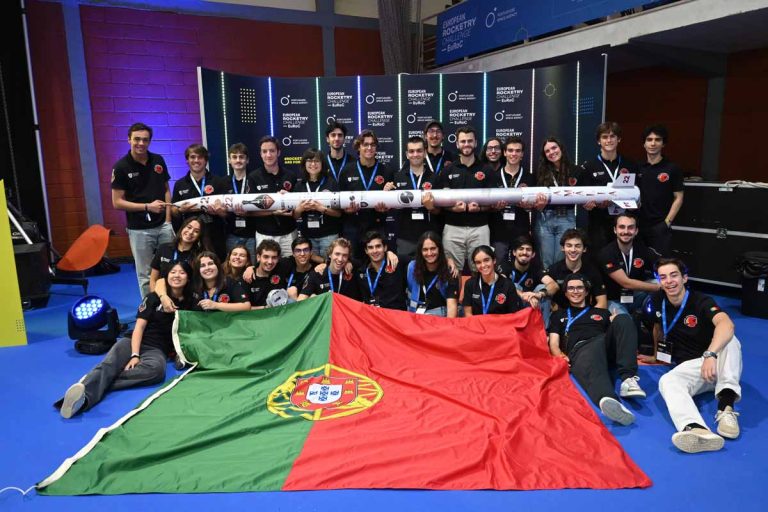
Ready for the European Stage: Once these final propulsion refinements are complete and full-system integration is verified, PESSOA will be Go for Launch. The work completed so far has provided valuable insight into the vehicle’s behaviour and increased our confidence in the overall design. We are looking forward to demonstrating the capabilities of PESSOA through a safe and successful flight at the 2026 edition of the European Rocketry Challenge. Beyond simply competing, this mission carries historical weight for our team and country: RED aims to launch the first Portuguese rocket powered by a hybrid rocket engine.
A Final Thank You: Developing a highly complex SRAD aerospace vehicle from scratch is an immense challenge. We would like to extend our deepest gratitude to Eurocircuits for their unwavering support. Their commitment to empowering student engineering teams with industry-standard manufacturing, fast delivery, and powerful design verification tools has been instrumental in bringing the “brain” of PESSOA to life. As we head to the launch pad, we do so with the utmost confidence that our avionics are built to survive the journey.

For more information visit the Rocket Experiment Division website.
Bring your product to market on time and within budget – join the Eurocircuits Community


