
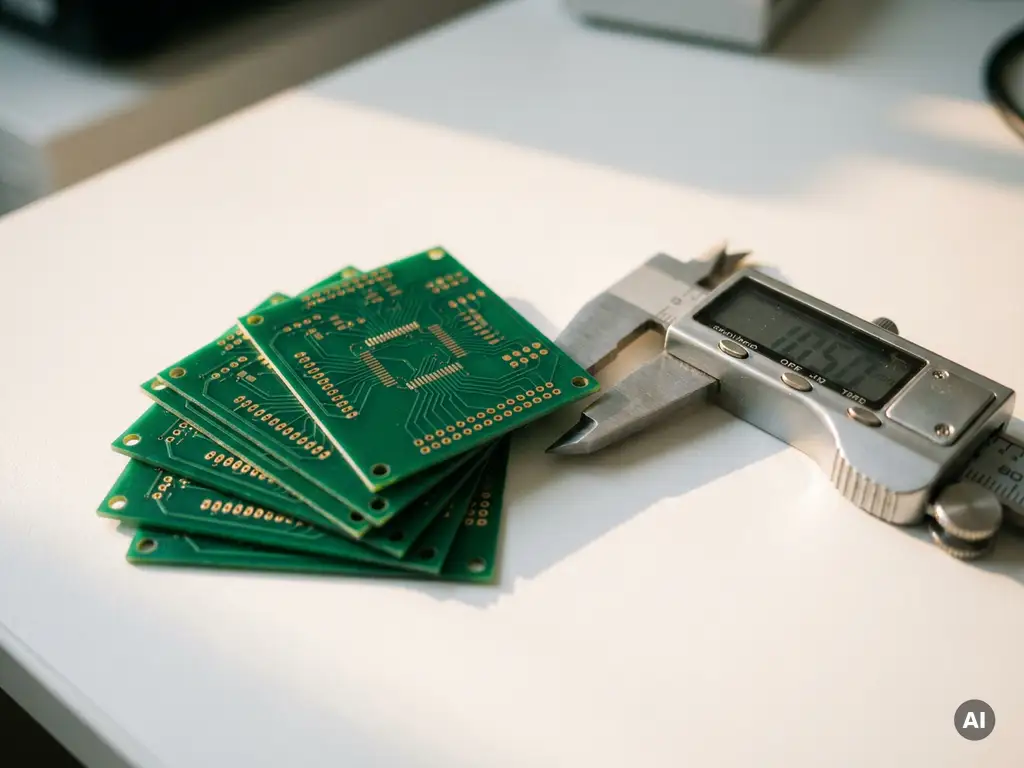
For most first engineering builds, ordering between 3 and 10 prototype PCBs is the right starting point. Three boards give you enough units to split across functional testing, environmental stress testing, and a spare, while staying within a budget that makes sense before your design is validated. The exact number depends on your testing plan, team size, and how confident you are in the design going in. The sections below break down the key decisions that shape your prototype PCB quantity, from NPI requirements to the cost-per-unit trade-off.
What factors determine how many prototype PCBs to order?
The right prototype PCB quantity is shaped by four core factors: your testing scope, the number of engineers or teams working in parallel, your tolerance for iteration risk, and your project timeline. A board destined for a single functional check needs far fewer units than one entering a full validation cycle with multiple test stations.
Start by mapping out every test the board needs to pass before it can move forward. Each distinct test phase, such as functional verification, signal integrity checks, thermal cycling, or EMC pre-compliance, typically consumes at least one board. If a test is destructive or risks damaging the board permanently, you need a dedicated unit for it. Add one spare for every two or three test boards to cover handling damage, rework attempts, or unexpected failures that require a fresh sample.
Team structure matters too. If two engineers are developing firmware and hardware simultaneously, a single prototype creates a bottleneck. Parallel workstreams almost always justify ordering at least one extra board per concurrent workstream. Finally, factor in your confidence level in the design. A first spin of a complex, high-layer-count board with new components warrants more units than a minor revision to a proven design.
How many prototype PCBs does a typical NPI project require?
A typical new product introduction (NPI) project requires 5 to 15 prototype PCBs across one or more build iterations, not in a single order. Early-stage prototypes, sometimes called EVT (Engineering Validation Test) builds, often start with 3 to 5 units. Later DVT (Design Validation Test) stages may call for 10 or more to support broader testing across different conditions and user scenarios.
NPI projects in sectors like industrial electronics, medical devices, or aerospace tend toward the higher end of this range because their validation protocols are more rigorous and often formally documented. A medical device, for example, may require boards for biocompatibility testing, software integration testing, and regulatory submission samples, all from the same build. Each requirement adds to the total count.
For EMS companies managing NPI on behalf of OEM clients, the prototype quantity also needs to account for client review samples and any boards retained for traceability or future reference. Planning for this upfront avoids a costly mid-project re-order that delays the programme. Exploring PCB and PCBA services early in the NPI planning stage can help align build quantities with validation milestones.
Should you order more PCBs to reduce the cost per unit?
Ordering more prototype PCBs does reduce the cost per unit, but this trade-off only makes financial sense if you are confident the design is stable enough to use all the boards. The fixed costs of setup, tooling, and data preparation are spread across the full quantity, so the per-unit price drops meaningfully as you move from 3 boards to 10 or 20. Beyond that threshold, the savings per additional unit become smaller.
The risk is straightforward: if your first prototype spin reveals a significant design error, any boards beyond your minimum test quantity become scrap. Ordering 20 boards to save a few euros per unit is a poor trade if 15 of them end up unused because the layout needed a revision. For early-stage prototypes where design risk is high, keep quantities low and prioritise speed of iteration over unit cost.
Where ordering more makes sense is when you are approaching the final prototype stage and have high confidence in the design. At that point, ordering 15 to 25 boards instead of 5 can meaningfully reduce your per-unit cost while giving you enough units for comprehensive validation, customer samples, and retained reference boards, without the risk of wasting most of the batch.
What’s the difference between ordering prototypes and low-volume production?
Prototype PCB orders and low-volume production orders differ primarily in intent, quantity, and the level of design certainty behind them. Prototypes are ordered to validate a design, typically in quantities of 1 to 25 units, with the expectation that changes may follow. Low-volume production assumes the design is frozen and focuses on delivering consistent, repeatable boards, usually in quantities from 25 to several hundred units.
The practical differences show up in how orders are priced and processed. Prototype orders are optimised for speed and flexibility. Turnaround times are short, design rule checks catch issues early, and the process is built around the possibility of re-spins. Low-volume production prioritises consistency and cost efficiency over iteration speed.
For engineering teams, the transition from prototype to low-volume production is a deliberate milestone, not just a quantity increase. It signals that the design has passed validation, the bill of materials is locked, and the manufacturing files are production-ready. Jumping to low-volume production quantities before that milestone is reached is one of the most common and costly mistakes in product development, as any design change after that point means scrapping the entire batch.
When should you re-order prototypes instead of moving to production?
You should re-order prototypes rather than moving to production whenever testing reveals a change that affects the PCB layout, stackup, component placement, or electrical performance. If the design files need to change, the board needs to be re-prototyped. Moving to production with an unvalidated change is a significant quality and cost risk, particularly in regulated industries.
Common triggers for a prototype re-order include:
- Signal integrity issues discovered during testing that require trace rerouting or impedance adjustments
- Component substitutions that affect footprint, placement, or thermal management
- EMC pre-compliance failures that require layout changes such as ground plane modifications or filter additions
- Mechanical fit problems that require pad or connector repositioning
- Firmware-driven discoveries that expose hardware limitations needing a board-level fix
A useful rule of thumb is this: if you would not be comfortable shipping the product to a customer based on the current test results, you are not ready for production. Another prototype spin is almost always cheaper than a production recall or a failed regulatory submission. Keep prototype iterations tight in quantity and focused in scope, so each re-order directly addresses the specific failures identified in the previous build.
How Eurocircuits supports your prototype PCB quantity decisions
Eurocircuits is built around the exact challenges that make prototype quantity decisions difficult: design uncertainty, tight timelines, and the need to iterate quickly without wasting budget. Their platform and manufacturing approach directly address each stage of the prototype-to-production journey.
- Instant online pricing and data verification: Upload your design files and get immediate feedback on manufacturability alongside a live price for any quantity, so you can model the cost difference between ordering 5 and 15 boards before committing.
- PCB and PCBA Visualizer: Verify your design data virtually before production begins, catching errors that would otherwise consume prototype boards and delay your schedule.
- Fast turnaround: 88% of all orders are delivered within five working days, meaning a re-spin decision does not cost you weeks, keeping iteration cycles short and manageable.
- Low-volume production capability: When your design is validated, Eurocircuits scales from prototype quantities into low-volume production without changing supplier, preserving continuity and quality.
- European manufacturing and compliance: All boards are manufactured in Europe, supporting traceability and compliance requirements common in medical, industrial, and aerospace NPI programmes.
Whether you are planning your first prototype build or managing a multi-stage NPI programme, configure your PCB assembly order online to get instant pricing and start your build with confidence. If you have questions about the right approach for your project, the Eurocircuits team is available via the contact page.