
Powering Innovation: VUB Racing’s New Power Management PCB
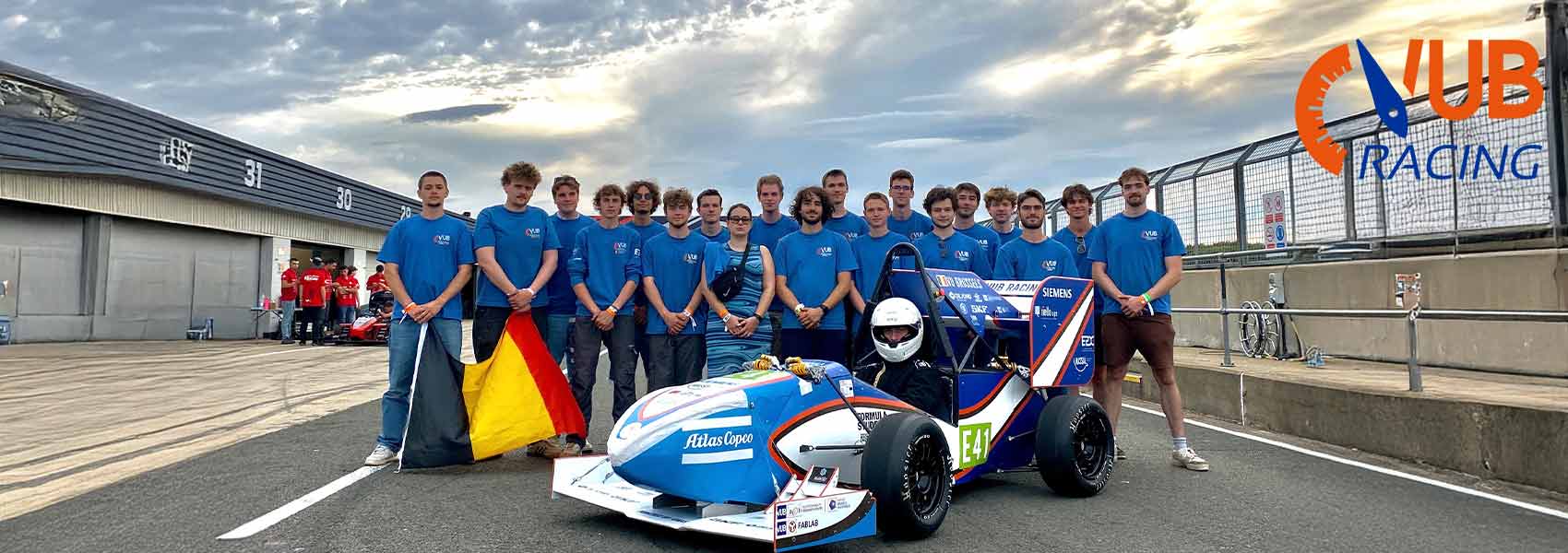
VUB Racing is a Formula Student team based in Brussels. Our mission is not only to build a competitive race car, but also to push sustainability in motorsport. We focus on designing and manufacturing a Formula Student car using eco-friendly materials wherever possible. To achieve this, the team integrates materials such as flax fibers, recyclable plastics, and other sustainable alternatives into the car’s design.
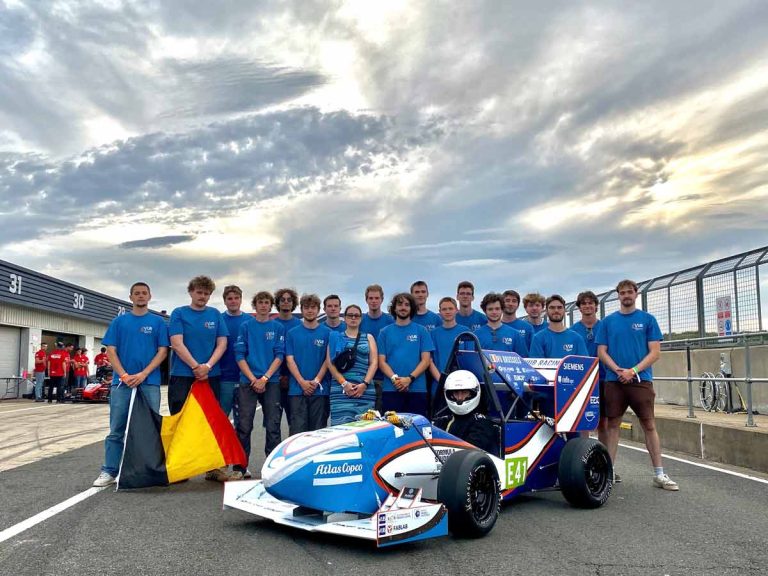
Last summer was an important milestone for our team. We competed in two major Formula Student competitions: Formula Student UK and Formula Student Italy. At FSUK, our team successfully drove the car for the first time during the dynamic events. Our car, Aion, completed the track sessions and proved that our design works in real racing conditions. Reaching the dynamic events was a huge achievement for the team and marked the first time we advanced this far in the competition.
This year we are aiming even higher. VUB Racing will compete in Formula Student Switzerland and Formula Student Germany with the ambition to perform even better and continue pushing innovation within the Formula Student competitions.
A key part of building a reliable race car is having a robust electronic architecture. Our partnership with Eurocircuits plays a crucial role in achieving this. Eurocircuits provides high-quality PCBs and enables us to iterate quickly thanks to their fast production and delivery times. Rapid iteration is essential in a student engineering project where designs continuously evolve.
In this blog post, we would like to showcase one of our latest developments for the car: the Power Management PCB.
The Power Management PCB
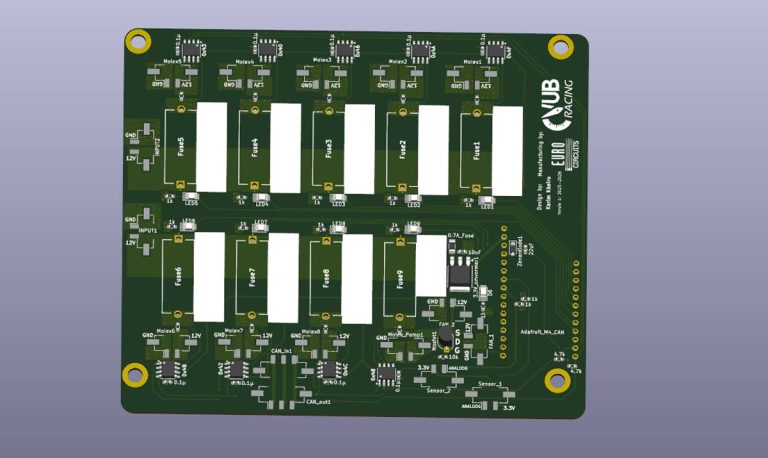
The Power Management PCB, located inside the TS-box, is responsible for managing and distributing power to all low-voltage components of the car. The primary goal of this circuit is to monitor and control the entire low-voltage system.
To achieve this, the PCB continuously measures the current, voltage levels, and power consumption of individual components. Monitoring these parameters allows the team to detect abnormal behavior in the electrical system and ensures that all components operate safely.
In addition to these measurements, the PCB also monitors the status of each fuse. This is done by measuring the voltage across the fuse. If the measured voltage drops below a defined threshold, the system detects that the fuse has blown. A corresponding LED then indicates which specific fuse is faulty, allowing for quick and efficient troubleshooting during testing or competitions.
At the heart of this system is the INA219BIDR power monitoring IC. This chip allows the microcontroller to receive real-time measurements such as current, bus voltage, and calculated power consumption. The IC integrates a high-side current sensing amplifier together with a 12-bit ADC. Making it well suited for accurate power monitoring in compact embedded systems like a Formula Student race car.
The current measurement is performed using a precision shunt resistor placed in series with the load. By measuring the voltage drop across this resistor, the INA219BIDR can accurately determine the current flowing through the circuit and calculate the corresponding power consumption. Communication between the monitoring IC and the microcontroller is handled through the I²C protocol. This bus allows multiple INA219BIDR devices to be connected in parallel on the same communication lines, each with its own configurable address. This makes it possible to monitor multiple power channels efficiently within the car’s electrical system.
The data collected by the Power Management PCB is extremely valuable for system diagnostics and performance optimization. It helps the team detect potential issues such as:
- an oversized or undersized battery
- short circuits
- abnormal power consumption
- failing components in the low-voltage system
By continuously monitoring the electrical system, we can improve reliability, quickly identify faults, and ensure the car performs optimally during testing and competitions.
With the support of partners like Eurocircuits, VUB Racing can keep pushing innovation forward both in sustainable materials and in advanced electronic systems that power the next generation of Formula Student race cars.

For more information please visit the VUB Racing website.
Bring your product to market on time and within budget – join the Eurocircuits Community


